
Mali
Mali contains Timbuktu, once one of the richest centres of learning in the world, with libraries of hundreds of thousands of manuscripts.
- CapitalBamakoOn the Niger River
- PopulationAbout 23 millionLandlocked in West Africa
- Area1,240,192 km2Around two thirds desert
- TimbuktuA medieval centre of learningHome to ancient manuscript libraries
Mali is landlocked and around two thirds desert, with the Sahara filling the north and Sahel and savannah in the south. The Niger River curves through the middle in a great arc and is the country's lifeline, supporting farming, fishing and transport.
In the 14th century the Mali Empire under Mansa Musa was one of the wealthiest states in the world, controlling the trans-Saharan gold and salt trade. Timbuktu became a centre of Islamic scholarship, with universities and libraries holding hundreds of thousands of manuscripts.
National symbols
- National animal Hippopotamus
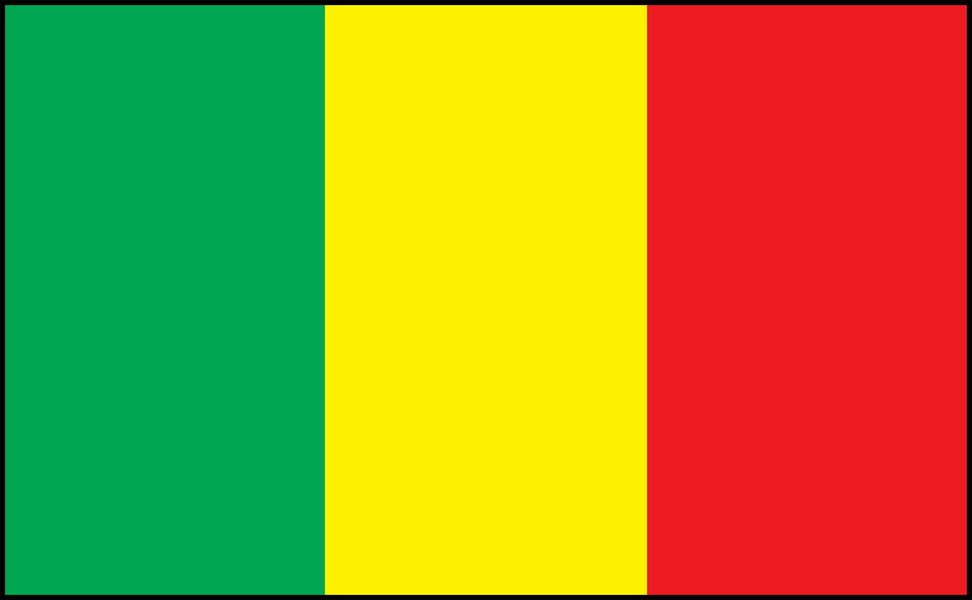
- National colours Green, yellow and red
- National anthem Le Mali (Translation: Mali)
- National day Independence Day, 22 September
Map of Mali
Geography
Mali covers 1,240,192 km2 and borders Algeria, Niger, Burkina Faso, Ivory Coast, Guinea, Senegal and Mauritania. It is landlocked.
The Sahara covers the northern two thirds. The Niger River enters from Guinea, curves north-east past Timbuktu and then turns south into Niger, creating a large inland delta where it floods each year. The Adrar des Ifoghas mountains rise in the far north-east.
Climate
Mali is hot for most of the year. The north is Saharan, with almost no rain and summer temperatures above 45C.
The Sahel belt across the middle has a short rainy season from June to September, and the far south gets substantially more rain. The harmattan blows dust from the Sahara between November and February.
Culture
Bambara is the most widely spoken language, and French was the official language until 2023 when 13 national languages were given official status instead.
Around 95 per cent of Malians are Muslim. Malian music is internationally admired: the kora, a 21-string harp-lute, and desert blues from the north have influenced musicians worldwide. Griots, hereditary storytellers and musicians, preserve family and national history orally.
Economy
Gold is the largest export, and Mali is one of Africa's biggest producers, continuing a trade that goes back to the medieval empire.
Cotton is the main cash crop and Mali is among the largest African producers. Most people farm millet, sorghum and rice, or herd livestock, and the economy is vulnerable to drought and, since 2012, to armed conflict in the north.
The flag
Three vertical bands of green, yellow and red, the pan-African colours in the same layout as the French tricolour.
Green stands for the land and its fertility, yellow for purity and mineral wealth, especially gold, and red for the blood shed in the struggle for independence. The original 1959 flag had a black human figure in the centre, removed in 1961.