
Malawi
Malawi is dominated by a lake so full of unique fish that it has more species than any other lake in the world.
- CapitalLilongweIn the central region
- PopulationAbout 21 millionLandlocked in south-east Africa
- Area118,484 km2A fifth of it covered by Lake Malawi
- Fish speciesOver 1,000 in Lake MalawiMore than any other lake
Lake Malawi fills the Great Rift Valley along the country's eastern edge and covers about a fifth of its area. It is around 580 km long and up to 700 m deep, and Malawians call it the Lake of Stars because of the way lanterns from fishing boats look at night.
The lake contains over 1,000 species of cichlid fish, more freshwater fish species than any other lake on Earth, and almost all of them evolved there and live nowhere else. Many are the brightly coloured fish sold for home aquariums.
National symbols
- National animal Thomson's gazelle, with the African fish eagle as national bird
- National colours Black, red and green
- National anthem Mulungu dalitsa Malawi (Translation: O God Bless Our Land of Malawi)
- National day Independence Day, 6 July
Map of Malawi
Geography
Malawi covers 118,484 km2 and borders Tanzania, Mozambique and Zambia. It is landlocked, and around a fifth of its area is water.
Lake Malawi runs down the eastern side in the Great Rift Valley. West of it the land rises to plateaus, and the Mulanje Massif in the south reaches 3,002 m, standing up abruptly from the plain like an island.
Climate
Malawi has a subtropical climate moderated by altitude. The wet season runs from November to April and the dry season from May to October.
The highlands are cool, especially in the dry winter months, while the lake shore and the Shire valley in the south are hot. Cyclones from the Indian Ocean occasionally reach Malawi and cause serious flooding.
Culture
English is an official language and Chichewa is the national language spoken by most people, along with Chiyao and Chitumbuka.
Around 83 per cent of Malawians are Christian and around 13 per cent Muslim. The Gule Wamkulu, a masked dance performed by the Chewa Nyau society, is on the UNESCO heritage list. Malawi is one of the most densely populated countries in Africa relative to its farmland.
Economy
Agriculture dominates and tobacco has long been the largest export, though the country is trying to diversify away from it. Tea, sugar and groundnuts are also grown.
Fishing on Lake Malawi feeds a large part of the population. Malawi is one of the poorest countries in the world, with limited industry and a heavy dependence on rain-fed farming.
The flag
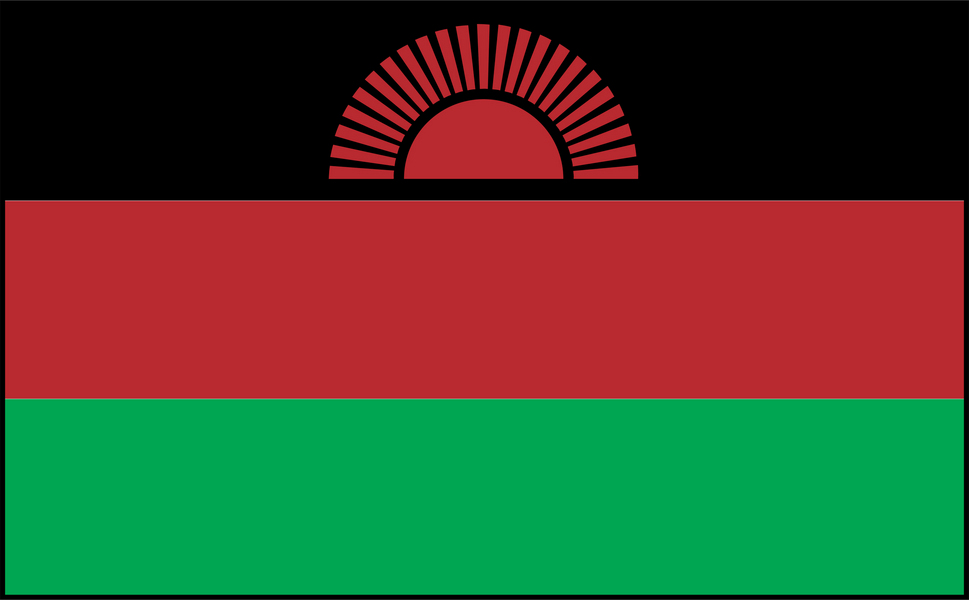
Three horizontal bands of black, red and green with a red rising sun of 31 rays on the black band at the top.
Black stands for the African people, red for the blood shed in the struggle for freedom, and green for the country's evergreen landscape. The rising sun represents the dawn of hope and freedom for Africa, with Malawi among the first wave of independent nations.