
Madagascar
Madagascar has been separated from every other landmass for around 88 million years, so around 90 per cent of its wildlife lives nowhere else.
- CapitalAntananarivoIn the central highlands
- PopulationAbout 30 millionOn the fourth largest island
- Area587,041 km2Fourth largest island in the world
- Unique wildlifeAbout 90 per centFound nowhere else on Earth
Madagascar split from Africa around 165 million years ago and from India around 88 million years ago. Its plants and animals have been evolving alone ever since, which is why roughly 90 per cent of them exist nowhere else.
That includes all of the world's lemurs, around 100 species of them, plus two thirds of the world's chameleons and the baobab trees whose fat trunks line the famous Avenue of the Baobabs.
National symbols
- National animal Ring-tailed lemur
- National tree Baobab
- National anthem Ry Tanindraza nay malala o (Translation: Oh, Our Beloved Fatherland)
- National day Independence Day, 26 June
Map of Madagascar
Geography
Madagascar covers 587,041 km2 and has no land borders, lying about 400 km off the south-east coast of Africa across the Mozambique Channel.
A spine of highlands runs down the middle, rising to Maromokotro at 2,876 m. The east coast is steep and rainforested, the west is drier with deciduous forest, and the south is spiny desert full of cactus-like plants found nowhere else.
Climate
The east coast is hot and very wet, catching trade winds off the Indian Ocean, with over 3,000 mm of rain a year in places. The highlands are cooler and milder.
The south and south-west are semi-arid and prone to severe drought. Cyclones strike the east coast between January and March and can be devastating.
Culture
Malagasy and French are both official. Malagasy is spoken across the whole island despite its size, which is unusual, though it has many regional dialects.
Around 85 per cent of Malagasy people are Christian, often practised alongside traditional beliefs about ancestors. The famadihana, or turning of the bones, is a ceremony in which families exhume ancestors, rewrap them in fresh cloth and dance with them before reburial.
Economy
Madagascar is one of the poorest countries in the world. Most people farm rice, cassava and maize for themselves.
Vanilla is the flagship export: Madagascar produces the large majority of the world's natural vanilla, hand-pollinated flower by flower. Cloves, coffee, nickel and sapphires are also exported, and ecotourism is growing.
The flag
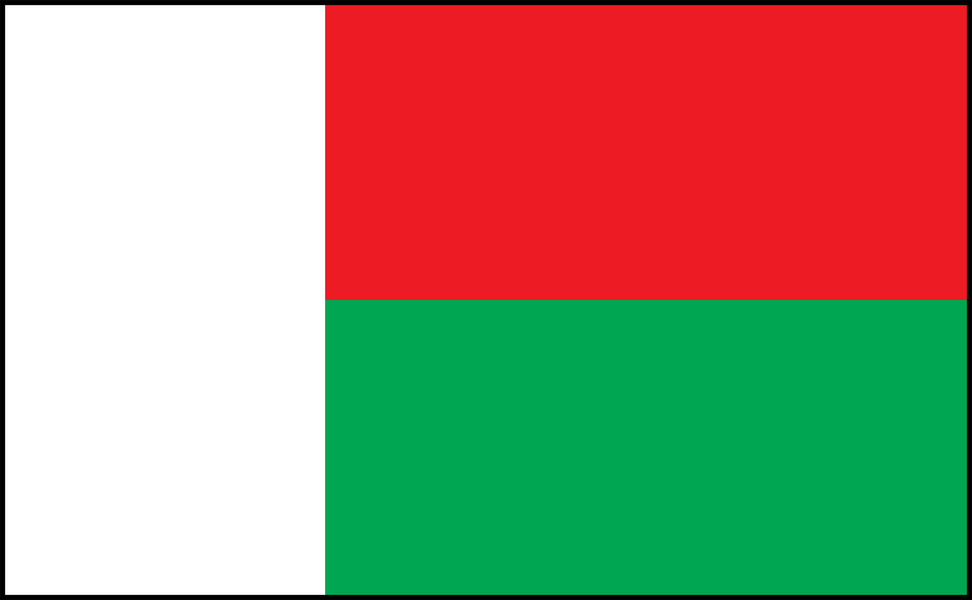
A white vertical band along the flagpole edge beside two horizontal bands, red above and green below.
Red and white were the colours of the Merina kingdom that ruled much of the island before French rule, and green is often said to stand for the Hova, the largest social group, and for hope. The flag was adopted in 1958.