
Libya
Libya is over 90 per cent desert, and it pumps water to its cities through the largest irrigation project ever built, drawing on an ancient underground sea.
- CapitalTripoliOn the Mediterranean coast
- PopulationAbout 7 millionAlmost all near the coast
- Area1,759,540 km2Fourth largest country in Africa
- Great Man-Made RiverAround 2,800 km of pipesThe largest irrigation project on Earth
Libya is mostly Sahara. Over 90 per cent of the country is desert or semi-desert, and almost the entire population lives on the narrow Mediterranean coastal strip in the north.
Beneath the desert lies the Nubian Sandstone Aquifer, water that fell as rain thousands of years ago when the Sahara was green. The Great Man-Made River project pumps it north through around 2,800 km of huge concrete pipes to supply Tripoli, Benghazi and the coastal farms.
National symbols
- National colours Red, black and green
- National anthem Libya, Libya, Libya
- National day Revolution Day, 17 February
- National emblem Crescent and star
Map of Libya
Geography
Libya covers 1,759,540 km2 and borders Egypt, Sudan, Chad, Niger, Algeria and Tunisia, with the Mediterranean Sea to the north.
The Sahara covers over 90 per cent of the country, including sand seas, rocky plateaus and the Tibesti mountains in the far south where Bikku Bitti reaches 2,267 m. The coastal strip and the Jebel Akhdar, or Green Mountain, in the north-east are the only well-watered areas.
Climate
The coast has a Mediterranean climate with mild wet winters and hot dry summers. Inland the climate becomes rapidly more extreme.
The Sahara here is one of the hottest and driest places on Earth, with summer temperatures above 45C and almost no rainfall. The ghibli, a hot dry southerly wind, can raise temperatures dramatically in hours and carry heavy dust.
Culture
Arabic is the official language, with Amazigh, Tuareg and Toubou languages spoken by minority communities.
Almost all Libyans are Muslim. Libya has five UNESCO World Heritage Sites, including the Roman cities of Leptis Magna and Sabratha, the Greek city of Cyrene, and rock art in the Acacus Mountains dating back thousands of years.
Economy
Oil dominates completely. Libya holds the largest proven oil reserves in Africa and depends on them for the great majority of government revenue and exports.
Since 2011 political division and conflict have repeatedly disrupted production. Agriculture is limited by water, though dates, olives and citrus are grown on the coast.
The flag
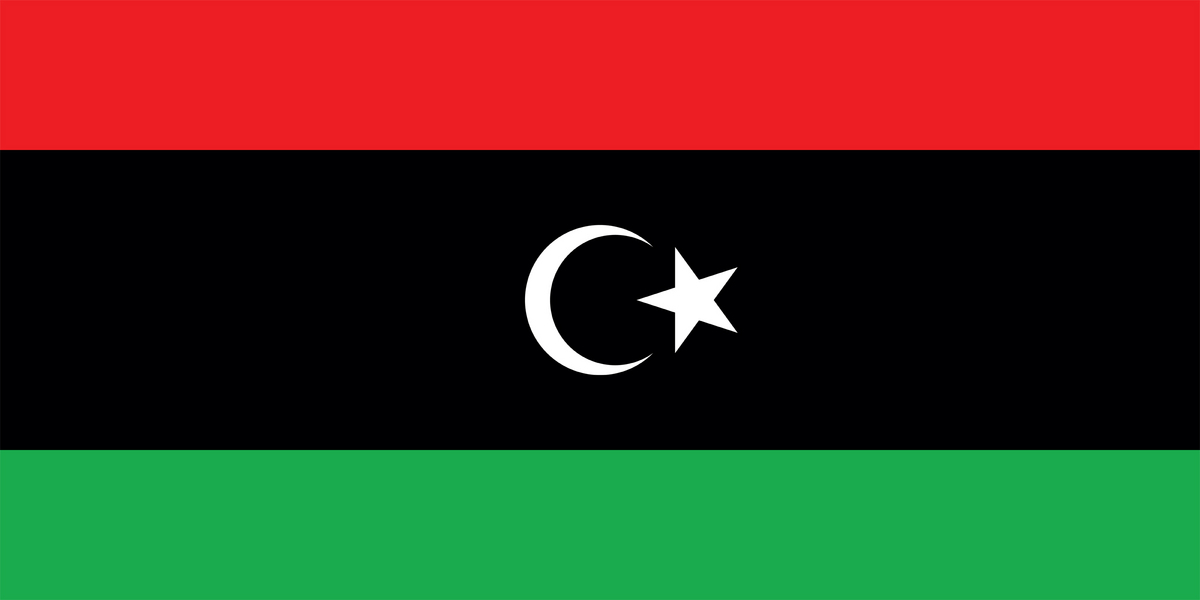
Three horizontal bands of red, black and green, with the black band twice the height of the others, carrying a white crescent and five-pointed star in the centre.
This was the flag of the Kingdom of Libya from 1951, replaced in 1977 by a plain green flag, the only single-colour national flag in the world, and restored in 2011. Red stands for the blood of those who fought for freedom, black for the dark years under Italian rule, and green for the country's wealth and for Islam.