
Liberia
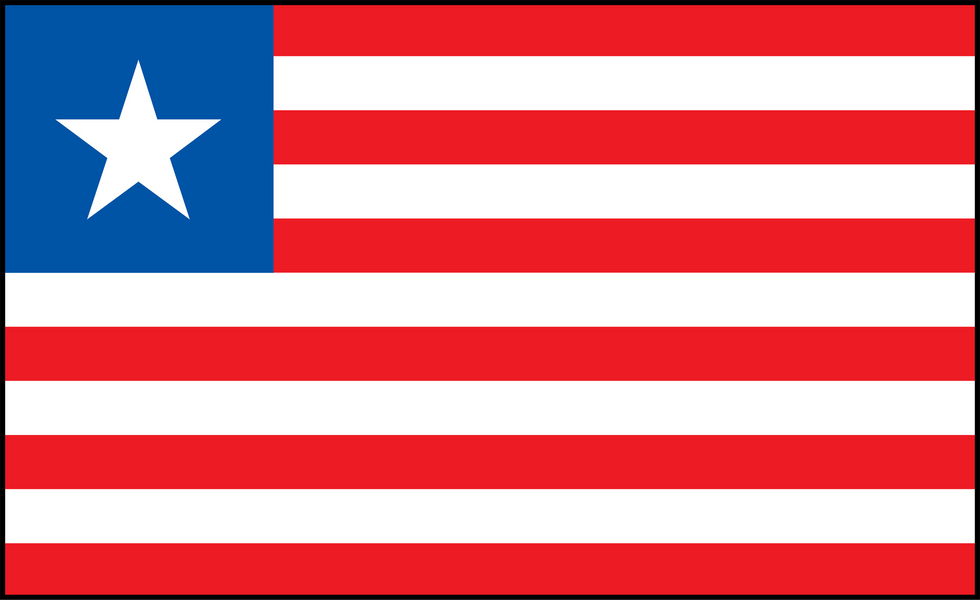
Liberia was founded by freed American slaves in the 1800s, and its flag is modelled on the American one.
- CapitalMonroviaNamed after US President James Monroe
- PopulationAbout 5.4 millionOn the West African coast
- Area111,369 km2Coast and rainforest
- Founded1822By freed slaves from the United States
Liberia was founded in 1822 as a settlement for freed African Americans, organised by the American Colonization Society, and declared independence in 1847. That makes it the oldest republic in Africa.
The country holds around 40 per cent of what remains of the Upper Guinean rainforest, one of West Africa's most important remaining forest blocks and home to pygmy hippos, forest elephants and chimpanzees.
National symbols
- National animal Pygmy hippopotamus
- National flower Pepper flower
- National anthem All Hail, Liberia, Hail!
- National day Independence Day, 26 July
Map of Liberia
Geography
Liberia covers 111,369 km2 and borders Sierra Leone, Guinea and Ivory Coast, with the Atlantic Ocean to the south-west.
A flat coastal plain with lagoons and mangroves rises to rolling hills and then to plateaus and mountains in the north, where Mount Wuteve reaches 1,440 m. Rainforest covers a large share of the interior.
Climate
Liberia is tropical with a long rainy season from May to October and a dry season from November to April.
Rainfall is among the highest in Africa, exceeding 4,000 mm a year on parts of the coast. Humidity is high throughout, and the harmattan brings dry dusty air briefly in December and January.
Culture
English is the official language, and around 20 indigenous languages are spoken, including Kpelle and Bassa. Liberian English is distinctive and widely used.
Around 85 per cent of Liberians are Christian and around 12 per cent Muslim. Liberia is one of only a few countries whose flag design deliberately echoes another nation's, reflecting its unusual founding.
Economy
Iron ore is the largest export, along with rubber: the Firestone plantation near Harbel has been one of the largest rubber operations in the world for a century.
Liberia also operates one of the largest ship registries in the world, and a substantial share of the global merchant fleet flies the Liberian flag. Two civil wars between 1989 and 2003 badly damaged the economy.
The flag
Eleven horizontal stripes alternating red and white, with a blue square in the top left corner containing a single large white five-pointed star.
It deliberately resembles the flag of the United States, reflecting Liberia's founding by freed American slaves. The eleven stripes stand for the eleven signatories of the Liberian declaration of independence, and the single star for Liberia as the first independent republic in Africa.