
Kenya
Kenya sits right on the equator, yet it has glaciers, because Mount Kenya rises to 5,199 m.
- CapitalNairobiThe only capital with a national park inside it
- PopulationAbout 55 millionOn the equator in East Africa
- Area580,367 km2From coral coast to alpine peaks
- Mount Kenya5,199 mGlaciers on the equator
Kenya runs from the Indian Ocean coast, through dry savannah plains, to the highlands split by the Great Rift Valley. Mount Kenya, an extinct volcano and the second highest mountain in Africa, still holds small glaciers despite sitting almost exactly on the equator.
The Maasai Mara in the south-west is where the great wildebeest migration arrives each year. Around 1.5 million wildebeest, plus zebra and gazelle, cross from Tanzania's Serengeti in one of the largest overland animal movements on Earth.
National symbols
- National animal Lion
- National flower Tropical orchid
- National anthem Ee Mungu Nguvu Yetu (Translation: O God of All Creation)
- National day Jamhuri Day, 12 December
Map of Kenya
Geography
Kenya covers 580,367 km2 and borders Ethiopia, Somalia, South Sudan, Tanzania and Uganda, with the Indian Ocean to the south-east.
The Great Rift Valley runs north to south through the country, dotted with lakes including Nakuru and Turkana, the largest desert lake in the world. Mount Kenya reaches 5,199 m. The north is arid, and the south-west highlands are fertile and cool.
Climate
Despite being on the equator, Kenya's climate depends mostly on altitude. The coast is hot and humid, the highlands around Nairobi are mild all year at around 1,800 m, and the mountain tops are freezing.
There are two rainy seasons: the long rains from March to May and the short rains from October to December. The north and north-east are semi-desert, and droughts there are frequent and severe.
Culture
Swahili and English are both official, and around 68 other languages are spoken. Swahili is the shared language across much of East Africa.
Around 85 per cent of Kenyans are Christian and around 11 per cent Muslim, mostly on the coast. The Maasai, with their red shukas and beadwork, are the most internationally recognised of Kenya's many peoples, though they are a minority within the country.
Economy
Agriculture is the backbone: Kenya is one of the world's largest tea exporters, and its cut flowers, mainly roses grown around Lake Naivasha, are flown daily to European markets.
Tourism built on safari and the coast is a major earner. Nairobi is a regional business hub, and Kenya pioneered mobile money with M-Pesa, which is used by most of the adult population.
The flag
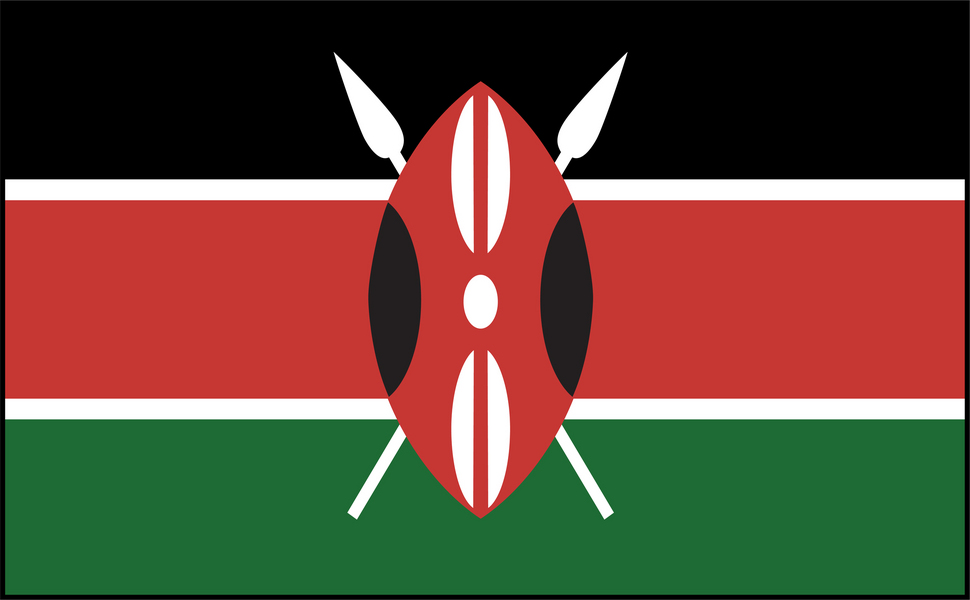
Three horizontal bands of black, red and green, separated by narrow white stripes, with a traditional Maasai shield and two crossed spears in the centre.
Black stands for the people, red for the blood shed in the struggle for independence, green for the land, and white for peace. The shield and spears stand for the defence of everything the other colours represent.