
Guinea-Bissau
Guinea-Bissau includes an archipelago of around 88 islands where saltwater hippos swim in the sea between them.
- CapitalBissauOn the Geba estuary
- PopulationAbout 2.2 millionOne of the smaller West African countries
- Area36,125 km2Mainland plus the Bijagos islands
- BijagosAround 88 islandsA UNESCO biosphere reserve
Guinea-Bissau is small, low and green, with a coastline broken up by estuaries, mangroves and creeks. Off the coast lie the Bijagos, an archipelago of around 88 islands, only about 20 of which are permanently inhabited.
The islands are a UNESCO biosphere reserve and one of the few places where hippos have adapted to living in salt water, swimming between islands and through the surf.
National symbols
- National animal Hippopotamus
- National colours Red, yellow, green and black
- National anthem Esta e a Nossa Patria Bem Amada (Translation: This Is Our Beloved Homeland)
- National day Independence Day, 24 September
Map of Guinea-Bissau
Geography
Guinea-Bissau covers 36,125 km2 and borders Senegal and Guinea, with the Atlantic Ocean to the west.
The mainland is low and flat, cut by wide tidal rivers and fringed with mangroves, with the highest point only around 300 m in the south-east. The Bijagos archipelago of around 88 islands lies offshore and is a protected biosphere reserve.
Climate
Guinea-Bissau is tropical with a rainy season from June to October and a dry season from November to May.
Rainfall is heavy, over 2,000 mm a year on the coast, and the country is hot and humid throughout. The harmattan brings dry dusty air from the Sahara in the dry months.
Culture
Portuguese is the official language but relatively few people speak it fluently. Guinea-Bissau Creole is the shared everyday language, and around 20 local languages are spoken.
Around 46 per cent of the population is Muslim, around 31 per cent follow traditional beliefs, and around 19 per cent are Christian. Gumbe music blends around ten of the country's folk traditions into one popular style.
Economy
Cashew nuts are overwhelmingly the largest export, making up the great majority of foreign earnings. Guinea-Bissau is one of the world's leading raw cashew exporters.
Fishing licences sold to foreign fleets are the other significant income. It is one of the poorest countries in the world, and repeated coups since independence have made stable government difficult.
The flag
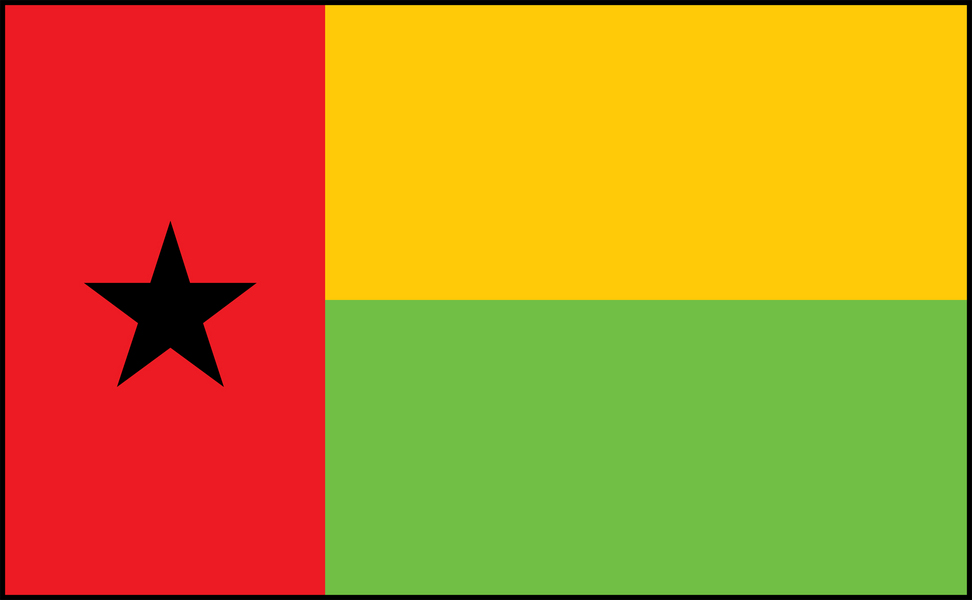
A red vertical band at the flagpole edge bearing a black five-pointed star, beside two horizontal bands, yellow above and green below.
These are the pan-African colours. Red stands for the blood shed in the war of independence from Portugal, yellow for the sun and the country's mineral wealth, green for its forests and farmland, and the black star for African unity.