
Ethiopia
Ethiopia has its own calendar with 13 months, and its clock starts counting the day at sunrise rather than midnight.
- CapitalAddis AbabaAt around 2,355 m, one of the highest capitals
- PopulationAbout 127 millionSecond most populous in Africa
- Area1,104,300 km2Highlands, rift valley and desert
- Calendar13 monthsAnd around 7 years behind the Western one
Ethiopia is dominated by a high plateau split by the Great Rift Valley. Because so much of the country sits above 1,500 m, it is far cooler than its latitude suggests, and Addis Ababa is one of the highest capital cities in the world.
Ethiopia is the only African country never colonised by a European power. It defeated an Italian invasion at the Battle of Adwa in 1896, which made it a symbol of independence across the continent.
National symbols
- National animal Lion, and the Ethiopian wolf, the rarest canid in the world
- National bird Wattled ibis
- National anthem Wodefit Gesgeshi, Widd Innat Ityopya (Translation: March Forward, Dear Mother Ethiopia)
- National day Derg Downfall Day, 28 May
Map of Ethiopia
Geography
Ethiopia covers 1,104,300 km2 and borders Eritrea, Djibouti, Somalia, Kenya, South Sudan and Sudan. It became landlocked when Eritrea gained independence in 1993.
The Ethiopian Highlands, sometimes called the Roof of Africa, cover much of the country and rise to Ras Dashen at 4,550 m. The Great Rift Valley cuts through them, and the Danakil Depression in the north-east is one of the lowest and hottest places on Earth at around 125 m below sea level.
Climate
Altitude decides everything. The highlands are temperate and pleasant all year, around 15C to 25C, which is why most Ethiopians live there.
The lowlands are hot, and the Danakil Depression regularly exceeds 45C and has recorded some of the highest average annual temperatures anywhere. The main rainy season runs from June to September.
Culture
Amharic is the federal working language, written in the Ge'ez script, one of the few writing systems developed in Africa. Oromo, Somali and Tigrinya are also widely spoken, and over 80 languages exist in total.
Around 68 per cent of Ethiopians are Christian, mostly Ethiopian Orthodox, one of the oldest churches in the world, and around 31 per cent Muslim. Injera, a large spongy sourdough flatbread, is the base of nearly every meal.
Economy
Agriculture employs most of the workforce. Coffee is the leading export, and Ethiopian beans from regions like Yirgacheffe and Sidamo are prized by specialist roasters.
Cut flowers, khat, sesame and gold are also exported. The Grand Ethiopian Renaissance Dam on the Blue Nile is Africa's largest hydroelectric project and has caused long-running disputes with Egypt and Sudan over water.
The flag
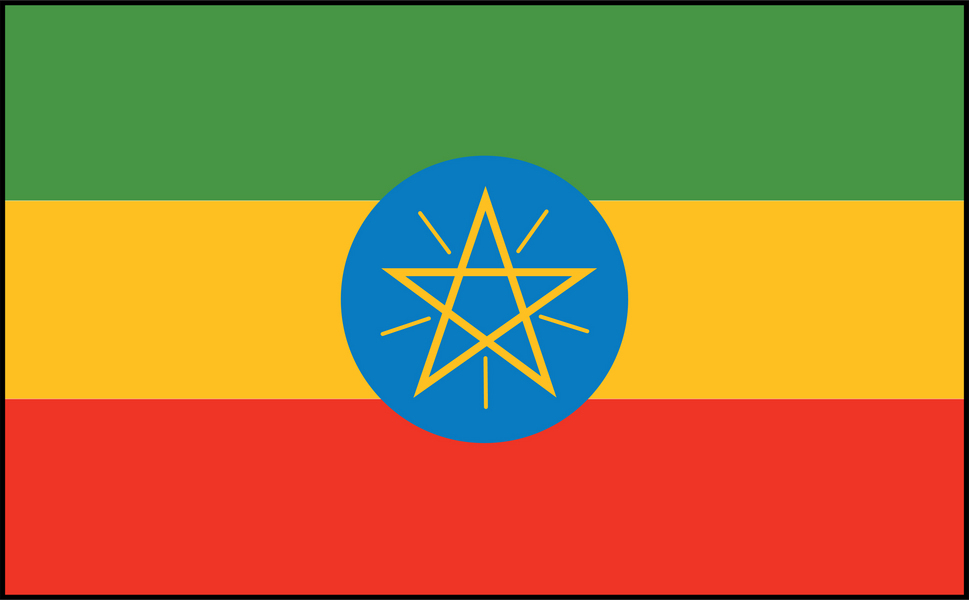
Three horizontal bands of green, yellow and red with a blue disc in the centre bearing a yellow star with rays.
Ethiopia was using green, yellow and red long before other African nations became independent, and because it was never colonised, many new African countries adopted the same colours in tribute. That is why they are called the pan-African colours. The star stands for the unity and future of Ethiopia's peoples.