
Egypt
Egypt is almost entirely desert, so nearly everybody lives along the Nile, on about 5 per cent of the country's land.
- CapitalCairoThe largest city in the Arab world
- PopulationAbout 113 millionAlmost all along the Nile
- Area1,001,450 km2Around 95 per cent desert
- Great PyramidBuilt around 2560 BCThe last surviving ancient wonder
Egypt is a desert country with a river running through it. The Nile flows north for about 1,500 km across Egypt and spreads into a delta at the Mediterranean, and that green ribbon is where over 95 per cent of Egyptians live.
Ancient Egypt lasted around 3,000 years, longer than the gap between its end and today. It built the pyramids at Giza, invented one of the earliest writing systems, and left temples and tombs preserved by the dry desert air.
National symbols
- National animal Steppe eagle
- National flower Blue lotus
- National anthem Bilady, Bilady, Bilady (Translation: My Homeland, My Homeland)
- National day Revolution Day, 23 July
Map of Egypt
Geography
Egypt covers 1,001,450 km2 and borders Libya, Sudan and Israel, with the Mediterranean Sea to the north and the Red Sea to the east.
Around 95 per cent of the country is desert: the Western Desert, part of the Sahara, and the Eastern Desert between the Nile and the Red Sea. The Sinai Peninsula, in Asia, holds Mount Catherine at 2,629 m. Lake Nasser, formed by the Aswan High Dam, is one of the largest artificial lakes in the world.
Climate
Egypt has a hot desert climate with very little rain. Cairo averages under 25 mm a year, and parts of the south can go years without measurable rainfall.
Summers are extremely hot, often above 40C inland, while the Mediterranean coast is milder. Winter nights in the desert can be cold. A hot dusty spring wind called the khamsin blows in from the Sahara.
Culture
Arabic is the official language, spoken in a distinctive Egyptian dialect that is widely understood across the Arab world because of Egypt's film and television industry.
Around 90 per cent of Egyptians are Muslim and around 10 per cent Christian, mostly Coptic Orthodox, one of the oldest Christian communities in the world. Egyptian cinema and music have shaped popular culture across the region for a century.
Economy
The Suez Canal is a major earner, with around 12 per cent of global trade passing through it and Egypt collecting the tolls.
Tourism to the pyramids, Luxor and the Red Sea resorts is significant. Agriculture along the Nile produces cotton, rice and sugar cane, and natural gas from the Mediterranean has grown into a leading export.
The flag
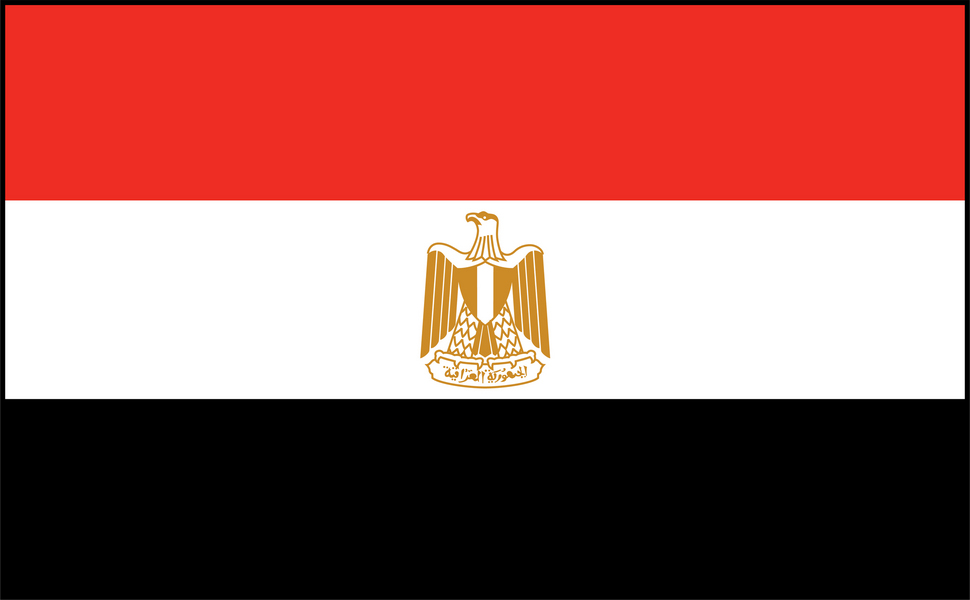
Three horizontal bands of red, white and black, the pan-Arab colours, with the gold Eagle of Saladin in the centre of the white band.
Red stands for the struggle against occupation, white for the peaceful 1952 revolution, and black for the end of oppression. The eagle is named after Saladin, the 12th-century sultan, and appears on several other Arab flags.