
Djibouti
Djibouti has a lake so salty that you float on it like a cork, and it sits 155 m below sea level.
- CapitalDjibouti CityAt the entrance to the Red Sea
- PopulationAbout 1.1 millionIn the Horn of Africa
- Area23,200 km2Mostly desert
- Lake Assal155 m below sea levelThe lowest point in Africa
Djibouti is a small, hot, mostly desert country guarding the Bab-el-Mandeb strait, the narrow gateway between the Red Sea and the Indian Ocean through which a large share of world trade passes. That position is the reason for its outsized strategic importance.
Lake Assal, in a volcanic crater, is the lowest point in Africa at 155 m below sea level, and one of the saltiest bodies of water in the world, around ten times saltier than the sea. Salt crystallises around its edges in white crusts.
National symbols
- National animal Beisa oryx
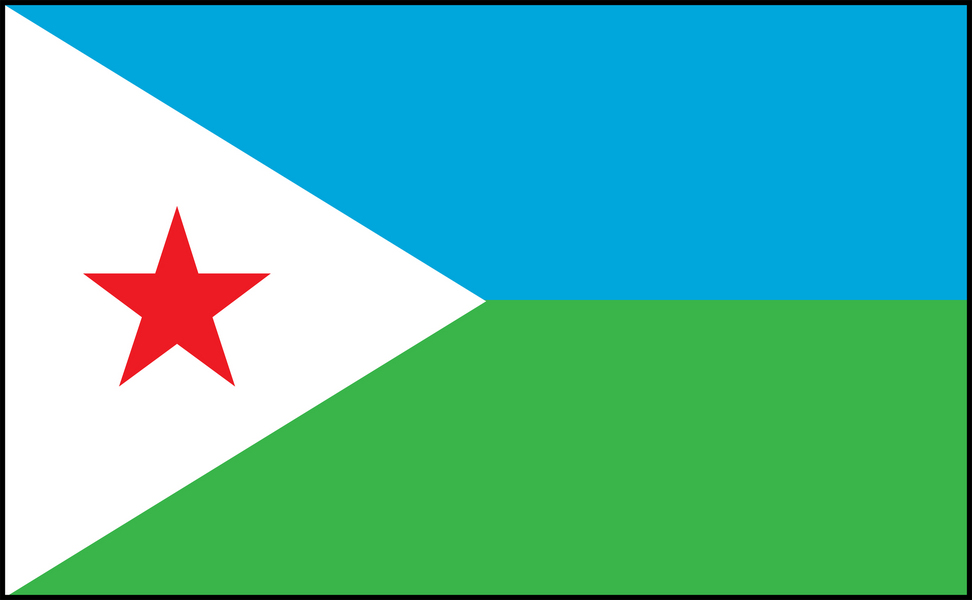
- National colours Blue, green, white and red
- National anthem Djibouti
- National day Independence Day, 27 June
Map of Djibouti
Geography
Djibouti covers 23,200 km2 and borders Eritrea, Ethiopia and Somalia, with the Gulf of Aden and the Red Sea to the east.
The country is mostly desert plateau and volcanic terrain, part of the Afar Triple Junction where three tectonic plates meet. Lake Assal is 155 m below sea level, and Mousa Ali on the Eritrean border is the highest point at 2,028 m.
Climate
Djibouti is one of the hottest countries on Earth. Summer temperatures regularly exceed 40C and can pass 45C, with high humidity on the coast.
Rainfall is extremely low, under 150 mm a year, and water scarcity is a permanent challenge. The khamsin, a hot dry inland wind, raises temperatures further in summer.
Culture
French and Arabic are both official, and Somali and Afar are the main spoken languages. The population is roughly 60 per cent Somali and 35 per cent Afar.
Around 94 per cent of Djiboutians are Muslim. Life is largely urban, with around 70 per cent of the population living in Djibouti City, which is unusual for the region.
Economy
Djibouti's economy runs on its ports. Landlocked Ethiopia, with over 120 million people, sends the great majority of its imports and exports through Djibouti.
Rents from foreign military bases add substantial income. There is very little farming because of the climate, so most food is imported.
The flag
A light blue band above a green band, with a white triangle at the flagpole edge bearing a red five-pointed star.
Blue stands for the sea and sky and traditionally for the Issa Somali people, green for the earth and for the Afar people, white for peace, and the red star for unity and for the blood shed in the struggle for independence from France in 1977.