
Democratic Republic of Congo
The Democratic Republic of Congo holds the second largest rainforest on Earth, after the Amazon.
- CapitalKinshasaThe largest French-speaking city in the world
- PopulationAbout 102 millionIn central Africa
- Area2,344,858 km2Second largest country in Africa
- CobaltAround 70 per cent of world supplyEssential for batteries
The DRC is the second largest country in Africa and sits astride the equator. The Congo Basin rainforest covers much of it, the second largest tropical forest in the world, and the Congo River loops through it, crossing the equator twice.
The Congo is the deepest river in the world, over 220 m in places, and carries more water than any river except the Amazon. Its rapids near the coast make it unnavigable to the sea, which is why the interior stayed unmapped by outsiders for so long.
National symbols
- National animal Okapi, a forest relative of the giraffe found only here
- National colours Blue, yellow and red
- National anthem Debout Congolais (Translation: Arise, Congolese)
- National day Independence Day, 30 June
Map of Democratic Republic of Congo
Geography
The DRC covers 2,344,858 km2 and borders nine countries, with only a 40 km stretch of Atlantic coastline.
The Congo Basin fills the centre, a vast low bowl of rainforest. Mountains rise in the east along the Great Rift Valley, including the Rwenzori range with glaciers on the equator, and the volcanic Virunga chain. Lake Tanganyika forms much of the eastern border.
Climate
The central basin is equatorial: hot, humid and wet all year with no dry season, which is what sustains the rainforest.
North and south of the equator there are distinct wet and dry seasons. The eastern highlands are much cooler because of altitude, and the Rwenzori peaks hold permanent ice despite sitting on the equator.
Culture
French is the official language, and Lingala, Kikongo, Swahili and Tshiluba are national languages. Over 200 languages are spoken in total.
Around 95 per cent of Congolese are Christian. Congolese rumba, which developed in Kinshasa and Brazzaville in the 1940s, spread across Africa and is on the UNESCO heritage list. Kinshasa is the largest French-speaking city in the world, larger than Paris.
Economy
The DRC has enormous mineral wealth: cobalt, copper, diamonds, gold, tin and coltan, which is used in electronics.
Despite that wealth it remains one of the poorest countries in the world, because decades of conflict, weak infrastructure and instability have prevented the benefits reaching most people. Most Congolese survive by subsistence farming.
The flag
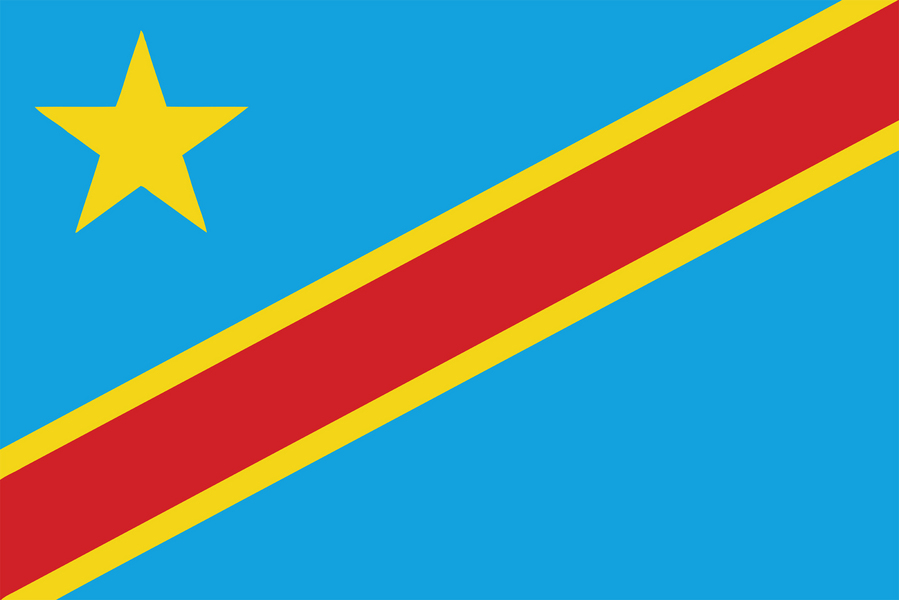
A sky blue field crossed diagonally by a red stripe edged in yellow, running from the bottom left to the top right, with a yellow five-pointed star in the top left corner.
Blue stands for peace, red for the blood of the country's martyrs, yellow for its wealth, and the star for a bright future. The DRC has changed its flag several times; this design, adopted in 2006, revives a version used at independence in 1960.