
Comoros
Comoros is where the coelacanth was rediscovered, a fish that scientists had believed extinct for 66 million years.
- CapitalMoroniOn Grande Comore
- PopulationAbout 850,000On three volcanic islands
- Area1,862 km2Between Madagascar and Mozambique
- Ylang-ylangA leading world producerA flower used in perfume
Comoros is a group of volcanic islands in the Mozambique Channel between Madagascar and the African mainland. Mount Karthala on Grande Comore is one of the most active volcanoes in the world and erupts every few years.
The country claims a fourth island, Mayotte, which voted to remain a French territory. Comoros has had a very unstable history with around 20 coups or attempted coups since independence in 1975.
National symbols
- National animal Livingstone's fruit bat, with a wingspan up to 1.4 m
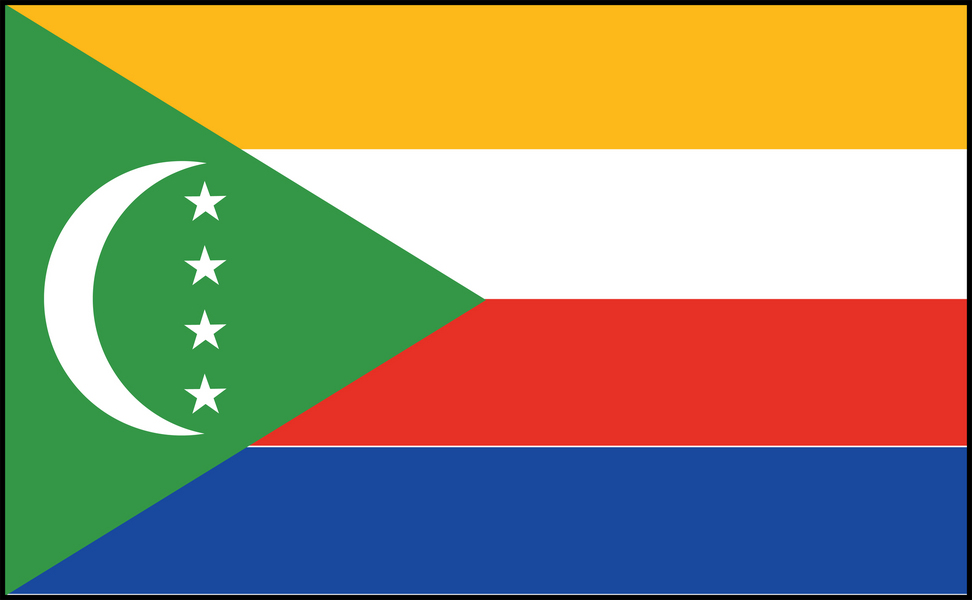
- National colours Green, white, red, yellow and blue
- National anthem Udzima wa ya Masiwa (Translation: The Union of the Great Islands)
- National day Independence Day, 6 July
Map of Comoros
Geography
Comoros covers 1,862 km2 and has no land borders, lying in the Mozambique Channel between Madagascar and Mozambique.
The three islands of the union, Grande Comore, Anjouan and Moheli, are all volcanic. Mount Karthala on Grande Comore reaches 2,361 m and holds one of the largest active volcanic craters in the world. The islands drop steeply into deep water, which is the coelacanth's habitat.
Climate
Comoros is tropical and warm all year at around 24C to 30C, with a hot wet season from November to April and a cooler drier season from May to October.
Rainfall is heavy in the wet season, and cyclones can strike the islands. Grande Comore has almost no surface rivers because rainwater drains straight through the porous volcanic rock.
Famous landmarks
There are many points of interest in Comoros, including important landmarks, monuments and buildings such as the Badjanani Mosque, Karthala volcano, Grand Mosque de Vendredi and Sultan's Palace.
Comoros is famous for being part of a series of volcanic islands located in the Mozambique Channel in the warm Indian Ocean. Tourism is low here due to political disagreements which is a pity as the islands would otherwise make ideal tourist destinations as they comprise of stunning beaches, incredible marine life and lush vegetation.
Culture
Comorian, Arabic and French are all official. Comorian is closely related to Swahili and is written in both Arabic and Latin scripts.
Around 98 per cent of Comorians are Muslim. The Grand Marriage, an elaborate and expensive traditional wedding that can take years to save for, confers lasting social status on a man and is central to island society.
Economy
Comoros is one of the poorest countries in the world. Its main exports are vanilla, cloves and ylang-ylang essence, a combination sometimes called the perfume islands trade.
Fishing and subsistence farming support most families. Money sent home by Comorians living in France is a major source of income, and the country depends heavily on foreign aid.
The flag
Four horizontal bands of yellow, white, red and blue, with a green triangle at the flagpole edge carrying a white crescent and four white stars.
The four bands and four stars each stand for one of the four islands the country claims: Grande Comore, Anjouan, Moheli and Mayotte, which is administered by France. The crescent and the green field represent Islam.
