
Chad
Chad is named after a lake that has shrunk by around 90 per cent since the 1960s.
- CapitalN'DjamenaOn the Chari River
- PopulationAbout 18 millionLandlocked in central Africa
- Area1,284,000 km2Fifth largest in Africa
- Lake ChadShrunk about 90 per centSince the 1960s
Chad is a large landlocked country stretching from the Sahara in the north to savannah in the south. The Tibesti Mountains in the far north are volcanic and include Emi Koussi, the highest peak in the Sahara at 3,415 m.
Lake Chad, on the western border, was once one of the largest lakes in Africa. Drought and water diverted for irrigation have shrunk it by around 90 per cent since the 1960s, which has devastated the fishing and farming communities around it.
National symbols
- National animal Goat in the north and lion in the south, both on the coat of arms
- National colours Blue, gold and red
- National anthem La Tchadienne (Translation: The Chadian)
- National day Independence Day, 11 August
Map of Chad
Geography
Chad covers 1,284,000 km2 and borders Libya, Sudan, the Central African Republic, Cameroon, Nigeria and Niger. It is landlocked and around 1,600 km from the nearest coast.
The Sahara covers the north, including the volcanic Tibesti Mountains where Emi Koussi reaches 3,415 m. A central Sahel belt gives way to savannah in the south. Lake Chad in the west is shallow and shrinking.
Climate
Chad has three climate zones. The northern Sahara is hyper-arid with almost no rain and summer temperatures above 45C.
The central Sahel has a short rainy season from June to September, and the southern savannah gets substantially more rain over a longer season. Droughts are frequent and the desert is advancing southwards.
Famous landmarks
There are numerous famous landmarks, monuments and buildings in Chad including the Prehistoric paintings in the Tibesti Mountains, historical site of Begon II, Chad National Museum, Chad Cultural Centre, ancient city of Ouara, Grand Mosque, Cathedral, and Avenue Charles de Gaulle.
Chad is famous for its rich culture and diverse geography which is very interesting as it comprises of desert areas, rivers, lakes, beaches, mountains and plateau.
Culture
French and Arabic are both official, and over 120 languages are spoken across the country's many ethnic groups.
Around 55 per cent of Chadians are Muslim, mostly in the north, and around 40 per cent Christian, mostly in the south. That division has shaped much of the country's political history. Traditional music uses the kinde, a bow harp, and the balafon.
Economy
Oil, produced in the south since 2003 and piped through Cameroon to the Atlantic, provides most export earnings.
Cotton is the main cash crop, along with gum arabic and livestock. Chad is one of the poorest countries in the world, and most people are subsistence farmers or herders vulnerable to drought.
The flag
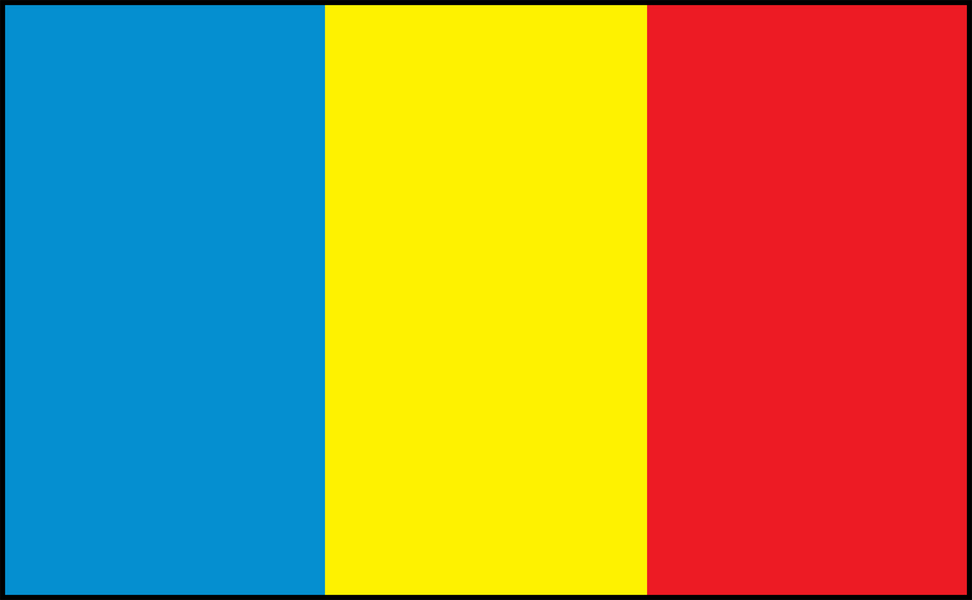
Three vertical bands of dark blue, gold and red. Blue stands for the sky, hope and the water of the south, gold for the sun and the northern desert, and red for progress and the blood shed for independence.
The flag is almost identical to Romania's, differing only in the shade of blue, which is darker on Chad's. Chad has raised the issue at the United Nations, but both countries continue to use their designs.
