
Central African Republic
The Central African Republic sits almost exactly in the middle of the continent, and its forests are home to forest elephants and lowland gorillas.
- CapitalBanguiOn the Ubangi River
- PopulationAbout 5.7 millionLandlocked in central Africa
- Area622,984 km2Savannah in the north, rainforest in the south
- Dzanga-SanghaA forest clearingWhere elephants gather in the hundreds
The Central African Republic is a landlocked country of savannah in the north and dense rainforest in the south, sitting near the geographical centre of Africa.
In the far south-west, the Dzanga-Sangha reserve contains a natural forest clearing where hundreds of forest elephants gather to drink mineral-rich water. It is one of the few places on Earth where these normally elusive animals can be watched in large numbers.
National symbols
- National animal Forest elephant
- National colours Blue, white, green, yellow and red
- National anthem La Renaissance (Translation: The Renaissance)
- National day Independence Day, 13 August
Map of Central African Republic
Geography
The Central African Republic covers 622,984 km2 and borders Chad, Sudan, South Sudan, the Democratic Republic of Congo, the Republic of Congo and Cameroon. It is landlocked.
Most of the country is a rolling plateau at around 600 m, forming the watershed between the Chad and Congo river basins. Dense rainforest covers the south-west, and Mont Ngaoui on the Cameroonian border is the highest point at 1,420 m.
Climate
The south is tropical with a long rainy season and high humidity, which supports the rainforest. The north is drier savannah with a distinct wet and dry season.
Temperatures are high all year, generally 25C to 34C. The harmattan brings dry dusty air from the Sahara to the north between December and February.
Famous landmarks
There are numerous fascinating landmarks, monuments and buildings in Central African Republic including the Tata Palace of Sultan Senoussi, Kaga-Kpoungouvou Caves that housed many slaves during their escape, stone settings at Bouar Megaliths, Presidential Palace, Boganda Museum, Notre-Dame Cathedral, Mosque, Museum and Zoo.
Central African Republic is famous for its stunning geography, tropical climate, rich culture and traditions, and the nation's love of arts, crafts, music and dance.
Culture
Sango and French are both official. Sango is a creole based on a local language and is spoken by almost the whole population, which is unusual for a country with over 80 ethnic groups.
Around 89 per cent of the population is Christian and around 9 per cent Muslim. The Ba'Aka of the southern forests have one of the world's most complex traditional vocal music styles.
Economy
Diamonds and gold are the main mineral exports, along with timber from the southern forests and cotton and coffee from farms.
Most people farm cassava, groundnuts and sorghum for their own families. Repeated civil conflict since 2012 has displaced large numbers of people and left the country dependent on international assistance.
The flag
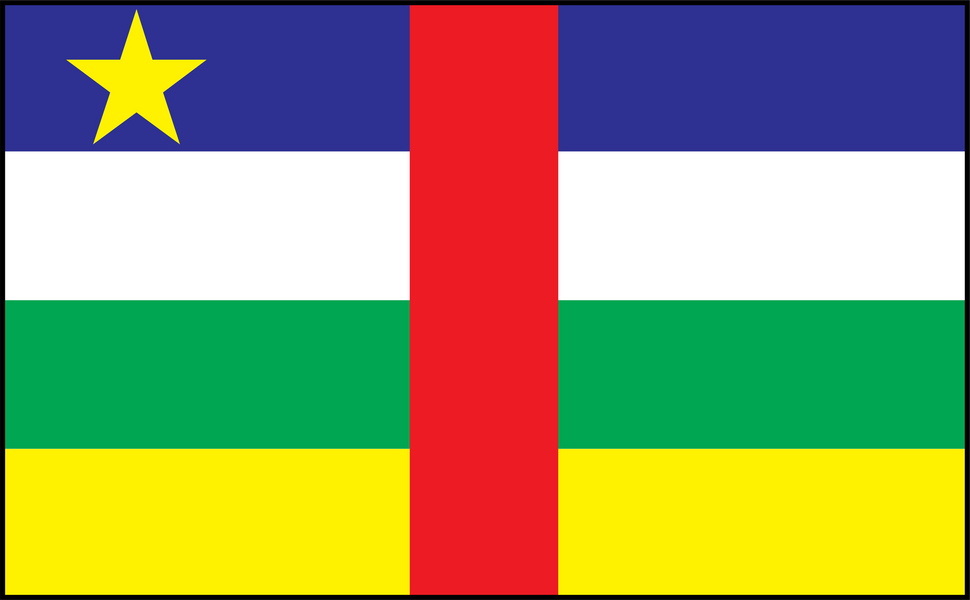
Four horizontal bands of blue, white, green and yellow, crossed vertically through the middle by a red stripe, with a yellow five-pointed star in the top left corner.
It deliberately combines the French colours, blue, white and red, with the pan-African colours, green, yellow and red, to represent the link between France and Africa. The red stripe crossing them stands for the blood shared by all people, and the star for independence.
