
Burundi
Burundi is one of the smallest countries in Africa, and it sits beside Lake Tanganyika, the second deepest lake in the world.
- CapitalGitegaMade political capital in 2019
- PopulationAbout 13 millionLandlocked in East Africa
- Area27,834 km2Small, hilly and densely populated
- Lake Tanganyika1,470 m deepSecond deepest lake on Earth
Burundi is small, landlocked and hilly, sitting on the edge of the Great Rift Valley beside Lake Tanganyika. It is one of the most densely populated countries in Africa, and almost everyone farms small hillside plots.
In 2019 the political capital was moved from Bujumbura, on the lake shore, to Gitega in the central highlands, though Bujumbura remains the economic centre and largest city.
National symbols
- National animal Lion
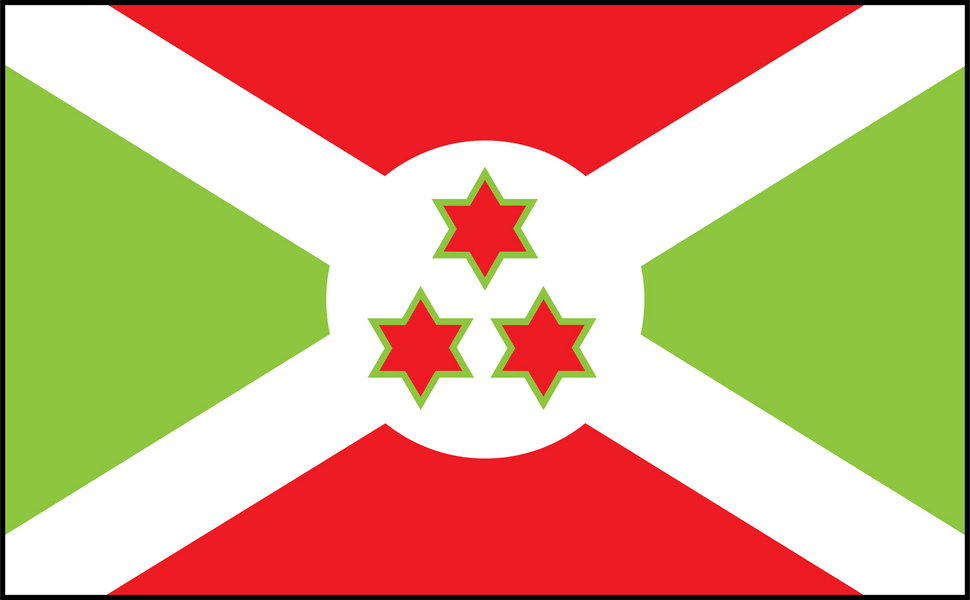
- National colours Red, white and green
- National anthem Burundi Bwacu (Translation: Our Burundi)
- National day Independence Day, 1 July
Map of Burundi
Geography
Burundi covers 27,834 km2 and borders Rwanda, Tanzania and the Democratic Republic of Congo. It is landlocked.
Most of the country is hilly plateau between 1,400 and 1,800 m, dropping in the west to the Rift Valley floor and Lake Tanganyika at around 770 m. Mount Heha is the highest point at 2,684 m.
Climate
Burundi has a moderate tropical highland climate because of its altitude, generally 20C to 27C in most of the country.
There are two rainy seasons, from February to May and September to November. The Rift Valley floor near Lake Tanganyika is noticeably hotter than the highlands, and the highest areas can be genuinely cool.
Famous landmarks
There are several important landmarks, monuments and buildings in Burundi including the Livingstone-Stanley Monument, Monument de l'Unite (of National Unity), Eglise Vivante de Jesus Christ (church), Regina Mundi Cathedral and Mausolee du Prince Louis Rwagasore.
The tourist trade in Burundi is centred mainly around the capital city of Bujumbura and the beautiful area of Lake Tanganyika. There are interesting things to see and do in Bujumbura with tourist attractions ranging from restaurants, bars and nightlife to museums, architecture, and places of worship including a cathedral and large mosque. Lake Tanganyika, located in the southwestern part of the country, is a popular tourist attraction. Its water spreads across four countries including Burundi, Tanzania, Zambia and the Democratic Republic of the Congo. It is the second oldest freshwater lake in the world by volume. Many species of fish and reptile can found living in Lake Tanganyika and its wetlands including crocodiles, terrapins, water cobras and cichlid fish.
Burundi is famous for being part of the Great African Lakes which occur in four African countries. Burundi forms part of the Albertine Rift in the western region of the East African Rift. This small country is home to hundreds of animals and plants, and has stunning landscapes and geographical features including national parks, forests, hot springs, lakes and rivers.
Culture
Kirundi, French and English are all official. Kirundi is spoken by essentially the entire population, which is unusual and makes Burundi linguistically very unified.
Around 93 per cent of Burundians are Christian. The Royal Drummers, or Abatimbo, are the best-known cultural export, and drumming has been recognised as a national heritage tradition with strict rules on who may perform it.
History
Among the population's ethic groups are the Hatu, Twa and Tutsi peoples who have inhabited the country for more than 500 years. Burundi was an independent Kingdom until the start of the 20th century when the area was colonized by the Germans. Both the Germans and Belgiums ruled over Burundi and neighboring Rwanda following WWI when Germany gave Burundi to Belgium. The European colony became known as Ruanda-Urundi.
Economy
Coffee and tea are the main exports, grown on hillside smallholdings. Burundi is one of the poorest countries in the world by income per person.
Almost 90 per cent of the population depends on subsistence farming. Fishing on Lake Tanganyika is important locally, and nickel deposits have been identified but not developed at scale.
The flag
A white diagonal cross divides the flag into red sections at top and bottom and green at the sides, with a white disc in the centre carrying three red six-pointed stars edged in green.
Red stands for the suffering of the independence struggle, green for hope, and white for peace. The three stars stand for the national motto, Unity, Work, Progress, and also for the three main population groups: Hutu, Tutsi and Twa.
