Burkina Faso

Where is Burkina Faso located? Burkina Faso is located on the continent of Africa. It is situated in West Africa, where it is landlocked by six countries. Its border countries are Mali, Niger, Benin, Togo, Ghana and the Ivory Coast (Cote D'Ivore).

Burkina Faso population and size The overall area size of this West African country is 274,000 sq km (105,900 square miles). Burkina Faso has an approximated population in the region of 17,322,700 with this landlocked country's most populated area being the capital city of Ougadougou.

The capital of Burkina Faso The capital city of Burkina Faso is Ougadougou which is positioned in the centre of the country. Ougadougou is the city with the highest population in Burkina Faso and has an estimated population of 1,086,500 people. The area is known for its national parks, array of wildlife, religious sites and historical points of interest. There are a range of fascinating landmarks in the city of Ougadougou including the Park of Bangr Weogo, National Museum of Ouagadougou, Grand Mosque of Ouagadougou, Cathedral of Ouagadougou, Moro-Naba Palace and the National Museum of Music. Ouagadougou is central to the economy and culture of Burkina Faso with textiles and foods being significantly important to its industries.

Burkina Faso major cities There are several major cities in Burkina Faso, the names of the largest and most important cities and towns include the country’s capital Ougadougou, and Bobo-Dioulasso, Koudougou, Ouahigouya, Banfora, Dédougou, Kaya, Dori, Tenkodogo and Réo. Bobo-Dioulasso is situated around 350km from the capital city of Ougadougou. It is the country's second largest city and has important cultural and economical significance. Bobo-Dioulasso has a population of more than 537,000 people, and both textile and agriculture are core to its economy. The city offers important air, road and rail connections to Ouagadougou.

During the early 1890s, the British, French and Germans all attempted to gain control of Burkina Faso, and in 1896, the French succeeded. The country achieved independence from France in 1960 and has since undergone many government changes. The country was formerly known as the Republic of Upper Volta and was renamed Burkina Faso on August 4, 1984.

Mare aux Hippopotamuses Facts In the flood plain of the Black Volta River, surrounded by forests, a very important freshwater lake exists. The area is known as the Mare aux Hippopotamuses meaning Lake of Hippopotamuses. The lake is popular with tourists and is important because it provides a home to around 100 hippopotamuses! The freshwater lake includes marches and pools, and is considered a wetland of international importance.

Shea Tree Facts The Shea Tree can be found growing in Burkina Faso. This particular tree species has significant importance as the nuts of the shea tree can be used to produce shea butter for use in local cuisine and cosmetics, or export to other countries where it is used for making numerous products including soap and chocolate. The shea tree has many purposes and is known by the term 'women's gold' as it is considered highly important. The bark of the tree is often used for medicinal purposes.

Map of Burkina Faso

Geography

There are many species of animals living in Burkina Faso. The country has one of the highest populations of elephants in Africa. It also has a large number of hippotamus species. The Mare aux Hippopotamuses is a freshwater lake full of hippopotamumes! A number of national parks are located across Burkina Faso which boast ecosystems that are rich in flora and fauna. The types of animals found living in this country include lions, leopards, antelopes, buffalos, cheetahs, caracals, wild dogs, baboons, monkeys and hyenas. The population of wild dogs is diminishing across Africa and this animal has become one of the continent's most endangered species.

The geography of Burkina Faso consists majorly of flat land with a some hills. However, the southwest part of Burkina Faso is dominated by a sandstone massif. This incredible area is bordered by cliffs that tower as high as 150m. The highest point of the sandstone massif reaches an elevation of 749m at Ténakourou. The names of the country's rivers include the Komoé River, Oti River, White Volta, Black Volta and Red Volta River.

The flora across Burkina Faso varies considerably across its forest and savanna grassland areas. All sorts of trees, plants and thorny scrub form part of the vegetation. One of the most common types of trees found growing in this country is the shea tree which is very important to the economy as it produces beans which can contribute towards the production of numerous products. The vigna subterranea (Bambara groundnut) is also commonly found growing in this country, as are species of acacia, Delonix regia, neem tree, and flamboyant tree.

Climate

The climate of Burkina Faso can be described as tropical. The country experiences dry, warm winters and wet, hot summers. The dry season is known as the Harmattan, and with this season comes dust which is brought in by dry winds that blow across the Sahara Desert. During the rainy season, Burkina Faso receives around 60-90cm of rainfall on average.

Famous landmarks

There are a number of incredible landmarks, monuments and buildings in Burkina Faso including the Cathedral of Ouagadougou, Cathredrale Notre Dame de Lourdes, Grand Mosque of Ouagadougou, Mosque of Bobo-Dioulasso, Grand Mosque at Bani, Ruins of Loropéni, Mare aux Hippopotames (Lake and National Park), religious sites, museums and national parks.

Unfortunately, tourism in Burkina Faso is currently limited as the country has fallen victim to terrorist attacks. Because of this, visitors are often advised against traveling to this country, particularly to northern areas due to their proximity with Mali. Hopefully, this will change in the future as the country has much to offer.

Burkina Faso is famous for its strong culture of art, music and sport, its wealth of wildlife species particularly the country's population of elephants and hippotamusses, its many religious sites, museums, national parks and lush vegetation.

Culture

The main languages of Burkina Faso include French, Mossi, Fula and Dyula. The official language is French but other common languages include Mossi, Dyula, Fula, Gourmanché and Bissa. There are more than 60 languages spoken throughout this multilingual country of Africa, with the majority being indigenous languages (native to the country).

The main religion of Burkina Faso is Islam. People belonging to the Islamic religion worship Allah. In the English language, the meaning of the word Allah is God in Islam. People from the religion of Islam believe in one god. It is thought that around 60 percent of Burkina Faso's population is Muslim and follow the practices of Islam. The rest of the population belong to various religions including Christian and Roman Catholic.

The cuisine in Burkina Faso can be described as flavorful and varied. Burkinabé cuisine is typically based around various types of fish and meats such as goat, mutton, beef and chicken. Grilled meat dishes are popular and are often accompanied by vegetables such as potatoes and yams, carrots, leeks, cucumber, spinach, corgettes and tomatoes. The most popular Burkinabe foods include tô or saghbo (polenta cakes), fufu (made from cassava), riz gras (rice dish with meat, onions, tomatoes), and meat skewers.

The culture of Burkina Faso is strongly influenced by the language, religion, arts, music, dance, sport and cuisine of the population, and as there are so many different ethnic groups present in this country, the culture can vary significantly. Sport plays an important part in the lives of many people here with the most popular types of sport being football, rugby, cycling, tennis, basketball and martial arts. Burkina Faso is proud to have a national football team. The culture is centred strongly around art, music and dance. Burkina Faso has a large community of artists and many crafts are produced locally. Music is hugely popular throughout the country and is often accompanied by dancing. In some parts of the country, it is tradition for certain groups to wear masks whilst performing their dances.

History

The first humans inhabitants began occupying this African country thousands of years ago. Archaeological discoveries of ancient tools, including those uncovered during excavation in 1973, support the existence of hunter gatherers which are believed to have existed in this part of Africa between 14,000 and 5,000 BC. Various different ethnic groups inhabited the country throughout early history including the Proto-Mossi, the Samo, the Dogon, the Songhai, and the Gwiriko Empire.

Economy

The economy of Burkina Faso relies heavily on agriculture. People rear livestock and produce their own crops such as maize, peanuts, millet and rice. The country hosts a very important international art and craft fair in its capital city. The fair is economically significant as it promotes goods and handicrafts produced by the people of Africa. Cotton and gold are two of the country's biggest exports. Burkina Faso's economic activity is funded by international aid.

The flag

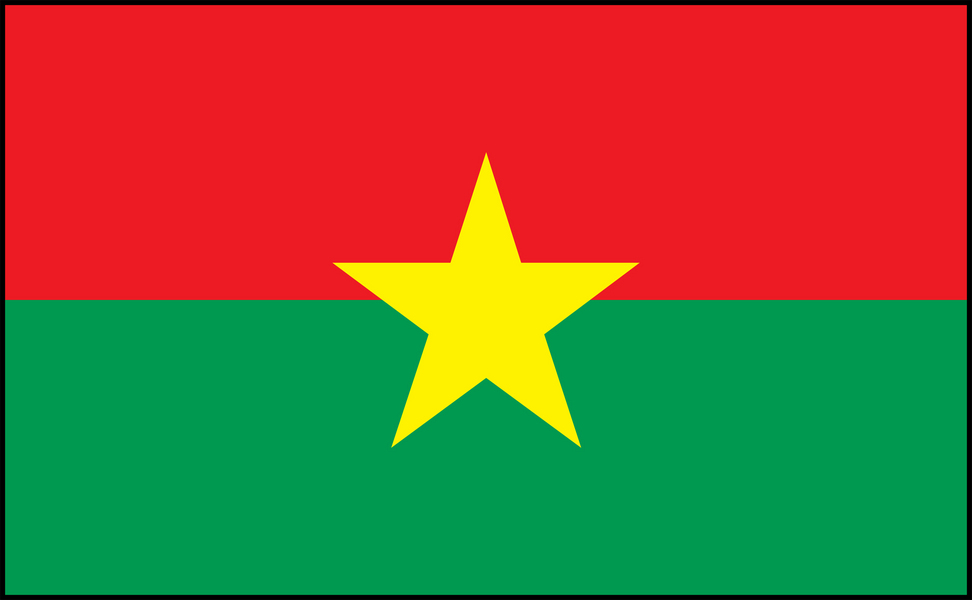
The national flag of Burkina Faso, designed with the use of Pan-African colours, came into use on August 4, 1984, and is characterized by two horizontal bars which are equal in size; red at the top and green at the bottom, with a five pointed yellow / gold star central to the flag's design. The Burkinabe flag has three Pan-African colours that hold significant symbolic meaning; red, gold and green. This set of colours derive from the flag of Ethiopia which has been influential to the design of many African country flags. The colour yellow represents wealth, red portrays Burkina Faso’s fight for independence whilst green illustrates hope.

Burkina Faso