
Benin
Benin is the birthplace of Vodun, the religion that became voodoo in the Caribbean and the Americas.
- CapitalPorto-NovoThough Cotonou is the seat of government
- PopulationAbout 14 millionA long narrow country in West Africa
- Area114,763 km2From coast to Sahel
- VodunA national religionWith its own public holiday
Benin is a long narrow country running north from a short Atlantic coast to the Sahel. The Kingdom of Dahomey, based here from the 1600s, was a powerful West African state known for its all-female military regiment, whom Europeans called the Dahomey Amazons.
Vodun originated among the Fon and Ewe peoples of this region. It is an official religion in Benin with a national holiday on 10 January, and it travelled to Haiti, Brazil and the American South with enslaved people, becoming voodoo and candomble.
National symbols
- National animal Leopard
- National colours Green, yellow and red
- National anthem L'Aube Nouvelle (Translation: The New Dawn)
- National day Independence Day, 1 August
Map of Benin
Geography
Benin covers 114,763 km2 and borders Togo, Burkina Faso, Niger and Nigeria, with a 121 km Atlantic coastline.
The coast is sandy with lagoons behind it, rising to a plateau and then to the Atakora mountains in the north-west, where Mont Sokbaro reaches 658 m. The far north is Sahel savannah near the Niger River.
Climate
The south is tropical with two rainy seasons, from April to July and September to November, and high humidity all year.
The north has a single rainy season from May to September and a longer dry season dominated by the harmattan wind. Temperatures are high throughout, often above 35C in the north before the rains.
Famous landmarks
There are a number of notable landmarks, monuments and buildings in Benin including the Cotonou Friendship Stadium, Place des Martyrs, Cotonou Cathedral, Cotonou Central Mosque, Ancien Pont Bridge, Foundation Zinsou, Porte du non retour, Temple des Pythons and the Royal Palaces of Abomey.
Benin has a growing tourist industry. Although the country doesn't currently attract large numbers of visitors, it does plan to develop tourism. There are plenty of things for tourists to see and do here. With stunning landscapes, coastal areas and a wealth of wildlife, this African country may one day become a great tourist destination. Some of the most popular tourist attractions in Benin include various religious sites, palaces, museums and national parks.
Benin is famous for its lush vegetation, geographical features and array of wildlife species. The country is steeped in history and is known for having being part of the Slave Coast during the early 16th to 19th century. Benin was sadly one of the main sources for African slaves which were forcibly involved in the Atlantic slade trade.
Culture
French is the official language, and Fon and Yoruba are the most widely spoken indigenous languages among more than 50 in total.
Around 49 per cent of Beninese are Christian, 28 per cent Muslim and around 12 per cent follow Vodun, though Vodun practices are woven through much of daily life regardless of stated religion. Ouidah hosts an annual Vodun festival drawing visitors from across the diaspora.
History
Benin was formerly known as Dahomey. From the 17th to 19th century, this African kingdom was heavily involved in the Atlantic Slave Trade. Located on the coast of the Atlantic Ocean, Dahomey formed part of the Slave Coast. Sadly, many African people were transported from Dahomey to the Americas where they were sold to the slave trade.
Economy
Cotton is the largest export by far and Benin is one of Africa's biggest producers, which is why it is sometimes called white gold here too.
The port of Cotonou handles trade for landlocked Niger and Burkina Faso as well as Benin. Most people farm maize, cassava, yams and beans, and cashew nuts and pineapples are growing exports.
The flag
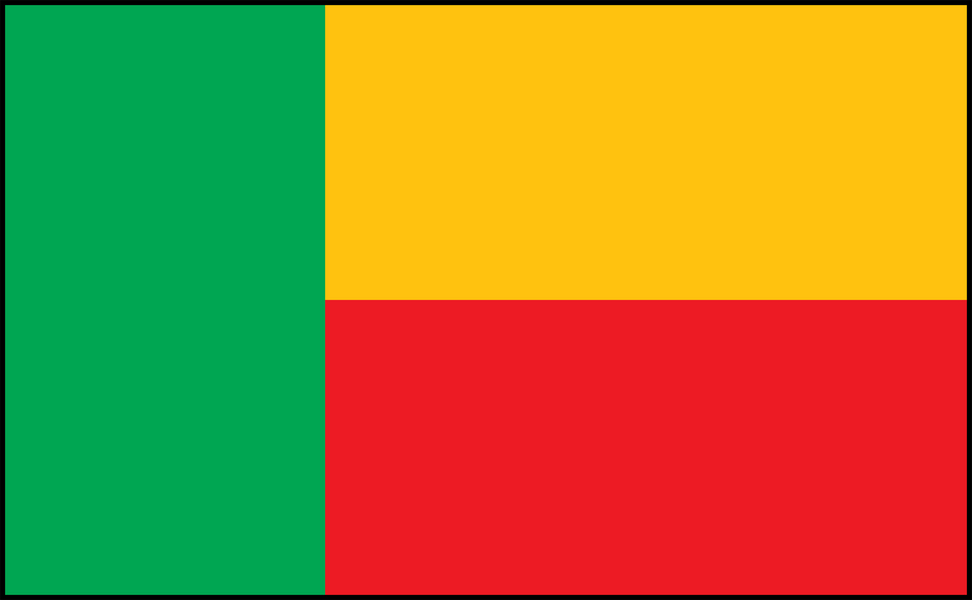
A green vertical band at the flagpole edge beside two horizontal bands, yellow above and red below.
These are the pan-African colours. Green stands for hope and renewal, yellow for the country's wealth, and red for the courage of its ancestors. The flag was used at independence in 1960, dropped during a Marxist period, and restored in 1990.
