
Angola
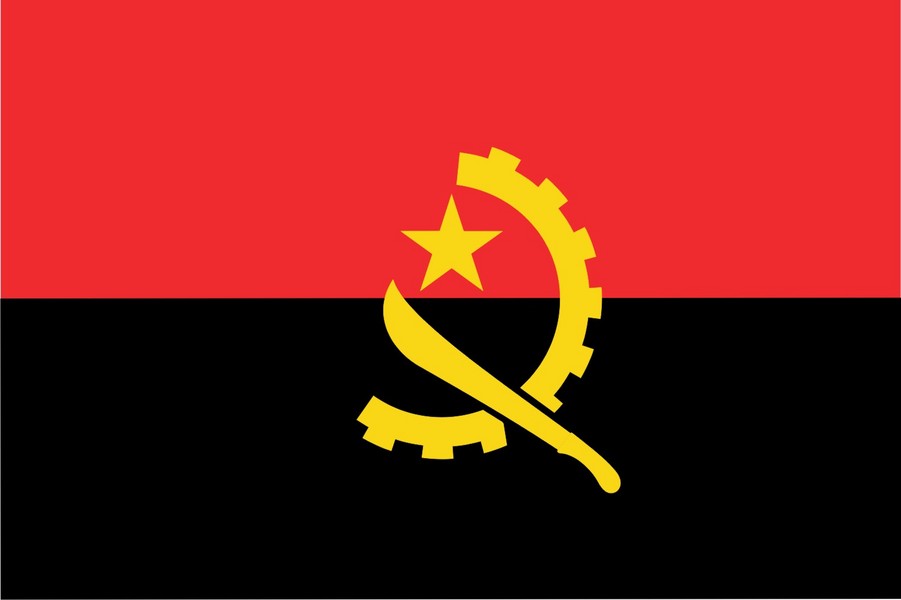
Angola is where the Okavango River begins, and it produces some of the world's finest diamonds.
- CapitalLuandaOne of the most expensive cities in the world
- PopulationAbout 36 millionOn the Atlantic coast of southern Africa
- Area1,246,700 km2Seventh largest in Africa
- LanguagePortugueseThe most spoken in the country
Angola runs inland from a long Atlantic coast to a high interior plateau. Rain falling on that plateau feeds rivers running in every direction, including the Okavango, which flows south-east into Botswana and creates the Okavango Delta.
The exclave of Cabinda, separated from the rest of the country by a strip of the Democratic Republic of Congo, holds a large share of Angola's offshore oil.
National symbols
- National animal Giant sable antelope
- National colours Red, black and gold
- National anthem Angola Avante (Translation: Forward Angola)
- National day Independence Day, 11 November
Map of Angola
Geography
Angola covers 1,246,700 km2 and borders Namibia, Zambia and the Democratic Republic of Congo, with the Atlantic Ocean to the west. The Cabinda exclave is separated from the rest of the country.
A narrow coastal plain rises sharply to a plateau covering most of the interior, reaching Morro de Moco at 2,620 m. The south-west has the Namib Desert, and the wetter north-east has rainforest.
Climate
Angola has a tropical climate in the north with a long rainy season, becoming drier towards the south where the Namib Desert reaches in.
The coast is surprisingly cool and dry for the tropics because of the cold Benguela Current, and Luanda gets under 350 mm of rain a year. The interior plateau is temperate because of its altitude.
Famous landmarks
There are a number of unusual landmarks, monuments and buildings in Angola including the Mausoleum of Agostinho Neto, Igreja Nossa Senhora dos Remedios (church), Miradouro da Lua (moon viewpoint), Christ the Statue, Ship's Cemetery, National Slavery Museum, Cidade Alta (parliament building), Palacio de Ferro (Iron Palace), old fortresses, churches and cathedrals of Angola.
Despite having stunning scenery, great beaches and many interesting landmarks, Angola is not a popular country with tourists. This African country suffered a long and damaging civil war and is still regaining its infrastructure.
Angola is famous for its beautiful scenery and unique geographical features. One of the most interesting tourist attractions is located approximately 40km from the capital city of Luanda at the Miradouro da Lua (Moon Viewpoint). Formed by a cluster of cliffs, this incredible beauty spot has become one of the most popular sights in Angola as it offers stunning views of the area's lunar-type landscape. Many interesting geographical features have occurred in this region as a result of erosion caused by wind and rain. Another interesting sight in Angola, which is somewhat a historical mystery, are the Black Rocks at Pungo Andongo. The rock formations are simply stunning with many of them forming the shape of animals.
Culture
Portuguese is the official language and is spoken by most Angolans, which is unusual in Africa where colonial languages are often a minority tongue. Umbundu, Kimbundu and Kikongo are widely spoken too.
Around 93 per cent of Angolans are Christian. Semba is the traditional music of Luanda and is one of the ancestors of Brazilian samba, carried across the Atlantic during the slave trade. Kizomba, a slow partner dance, developed here and spread worldwide.
History
Angola was once a Portuguese colony. The first arrivals from Portugal began settling in Angola following its discovery by Portuguese explorer, Diogo Cão, in 1484. They occupied areas alongside the coast where they established forts and trading posts. The Portuguese were heavily involved in the Atlantic Slave Trade which existed from the 15th to 19th centuries, and they primarily traded Angolan slaves. In 1836, slavery was abolished in Angola, however, the colonial government did not free all slaves until 1854.
The Angolan War of Independence began on February 4, 1961 and lasted for more than 13 years, coming to an end on November 11, 1975. The Portuguese were fighting three primary nationalist movements: MPLA (Popular Movement for the Liberation of Angola), UNITA (The National Union for the Total Independence of Angola), FNLA (The National Front for the Liberation of Angola). During the War of Independence, the nationalist movements were hindered by their failure to unite in their fight against the Portuguese. In 1974, the Carnation Revolution in Portugal caused the collapse of the Portuguese government which resulted in the end of all Portuguese military activity in Africa, which brought on a ceasefire and led to the end of the Angolan War of Independence. Angola was granted independence from Portugal on November 11, 1975 following the signing of the Alvor Agreement on January 15, 1975.
Economy
Oil dominates, providing most export earnings, with production concentrated offshore near Cabinda. Angola is one of Africa's largest oil producers.
Diamonds are the second export, and Angolan stones are known for high quality. Agriculture is being redeveloped after the war, and coffee, once a major export, is slowly returning.
The flag
A red band above a black band, with a gold emblem in the centre showing half a gearwheel crossed with a machete, beneath a five-pointed star.
Red stands for the blood shed in the struggle for independence and black for the African continent. The gearwheel represents industrial workers, the machete agricultural workers, and the star progress. The emblem is modelled on the Soviet hammer and sickle, reflecting the movement that led independence.
